

Staking overview
Staking in TON enables earning rewards by locking Gram to support network security and validation. TON supports several staking solutions, each designed for different use cases and operational models.
Staking secures the network through proof-of-stake. Depending on technical ability, stake size, and participation goals, users may choose between single nominator, nominator pools, or liquid staking. Some solutions are suitable only for technically experienced operators, while others are intended for businesses providing staking as a service. However, all solutions require non-trivial setup, and there are limited number of support tools.
Overview of staking solutions
The following smart contracts are commonly used in the TON ecosystem:
| Option | Intention | Features |
|---|---|---|
| Liquid staking | Staking providers servicing retail users. | Liquidity and DeFi integration via wrapped staking tokens. |
| Single nominator | Large holders staking only their own funds. | Secure, contract-based self-staking; simple ownership model. |
| Nominator pool | Small group of nominators delegating to one validator. | Has significant limitations; generally not recommended. |
Stake requirements
The technical minimum stake required to participate in validation is 300,000 GRAM. However, the actual minimum stake is typically higher, approximately 1,000,000 GRAM.
Scroll to the bottom of the validator stakes list to see the validator with the lowest stake included in the current round.
Liquid staking
The liquid staking contract enables staking services to issue liquid staking tokens (LSTs) that represent the underlying staking position. LSTs can be used in DeFi while the underlying GRAM earns rewards.
Key characteristics
- Users deposit GRAM and receive wrapped tokens, e.g. tsTON, that can be used in DeFi.
- Liquidity remains accessible even when underlying funds are staked.
- Flexible staker-validator connections without centralized pools.
- Low minimum deposits for broader participation.
- Some protocols allow governance influence.
- Reduced slashing risks using diversification.
- Easy fund spreading across validators.
Recommended use
- Staking providers serving retail users.
- Projects building liquid staking products or yield-bearing tokens.
- Operators who want to run staking services without committing significant personal funds.
Single nominator pools
Single nominator pool contract is the standard solution designed for large holders who want to stake their own funds while delegating validator operations to a trusted operator.
The single nominator pool contract is the recommended staking solution.
Key characteristics
- Supports exactly one nominator.
- Separates the owner's cold wallet from the validator's hot wallet to prevent theft if the validator node is compromised.
- The owner can recover stakes even in extreme scenarios, such as elector contract upgrades.
- Any modification would require a professional audit, which is costly and time-consuming; therefore, the contract remains intentionally unchanged.
Recommended use
This solution is suitable for:
- Large GRAM holders who stake only their own funds.
- Setups that require separation between fund custody (owner wallet) and validator node operations.
Nominator pools
Nominator pools are smart contracts that allow a small group of nominators to combine their funds and delegate to a validator for staking collectively. However, it has limitations and safety concerns.
The nominator pool is deprecated and is not recommended for use.
Limitations
- Only the owner can withdraw funds from the pool.
- Supports up to approximately 40 nominators, which is not suitable for large pools.
- Not designed for small deposits or retail participation.
- Sending a message to the pool without a bounce flag may result in funds becoming locked.
Notes
- The contract is not deprecated, but it is rarely an appropriate choice in practice.
- For large holders, the single nominator contract is preferred.
- This solution is not recommended for new staking services.
Differences from standard nominator pools
- Lower minimum stake of 50 GRAM, compared to 10,000 GRAM in standard pools.
- Custom contract architecture with separate owner, controller, proxy, and pool contracts.
- Fee model where deposit and withdrawal fees vary by pool; users should check pool details before staking.
Recommendations for staking solutions
For large holders staking only their own funds:
- Use a single nominator contract for direct self-staking, or
- Stake through a reputable third-party staking provider.
For operators intending to run staking services for others:
- Use liquid staking contracts, which are appropriate when accepting deposits from retail users or when building DeFi-compatible staking tokens.
For small holders:
- Use a third-party staking service rather than running contracts directly.
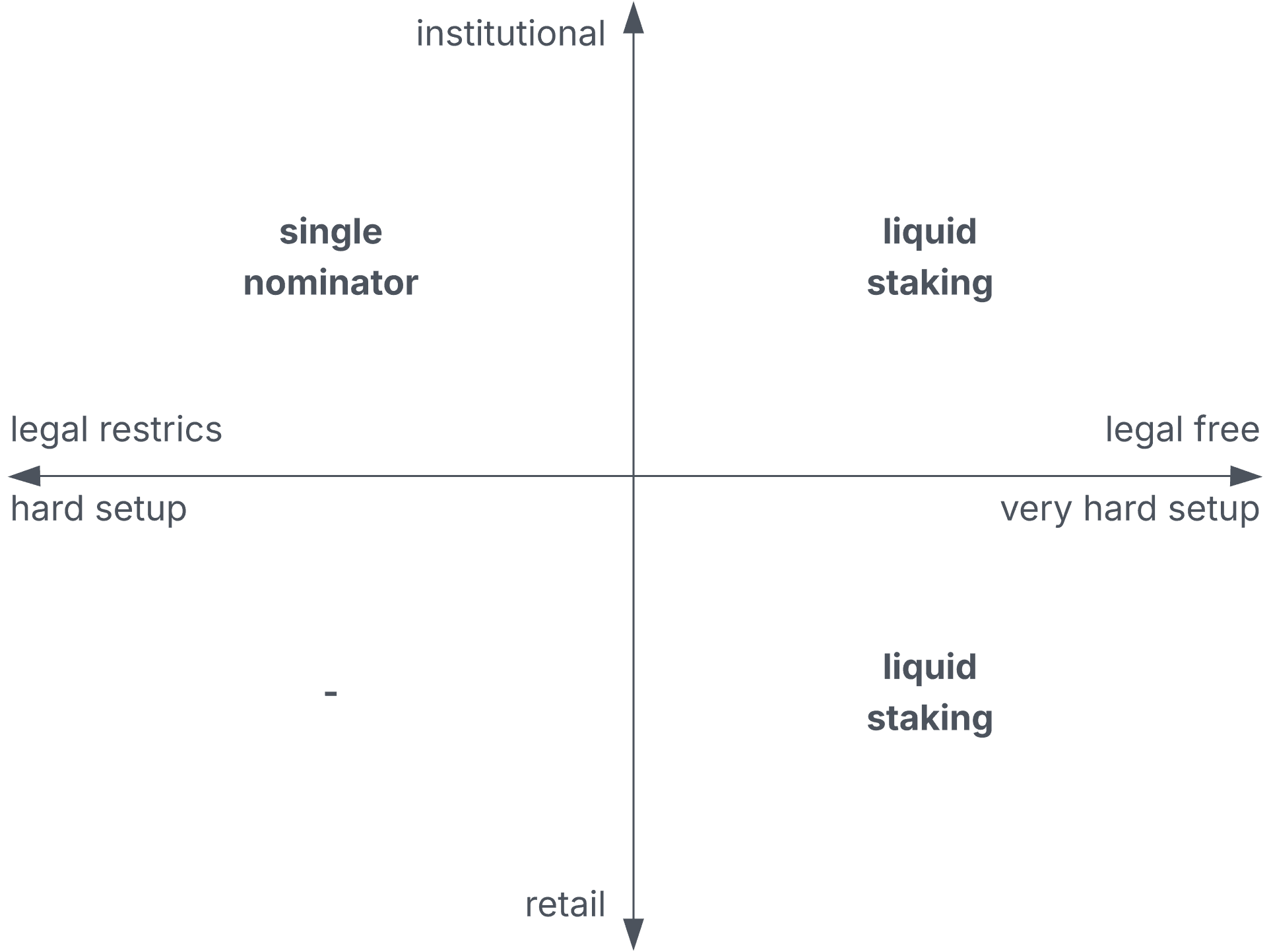
The following recommendations are mapped onto the Cartesian plane below. The horizontal axis represents legal restrictions and setup complexity, while the vertical axis represents the operational model.

All validators participating in third-party liquidity pool staking protocols use MyTonCtrl for validation. For validator setup instructions, see: